
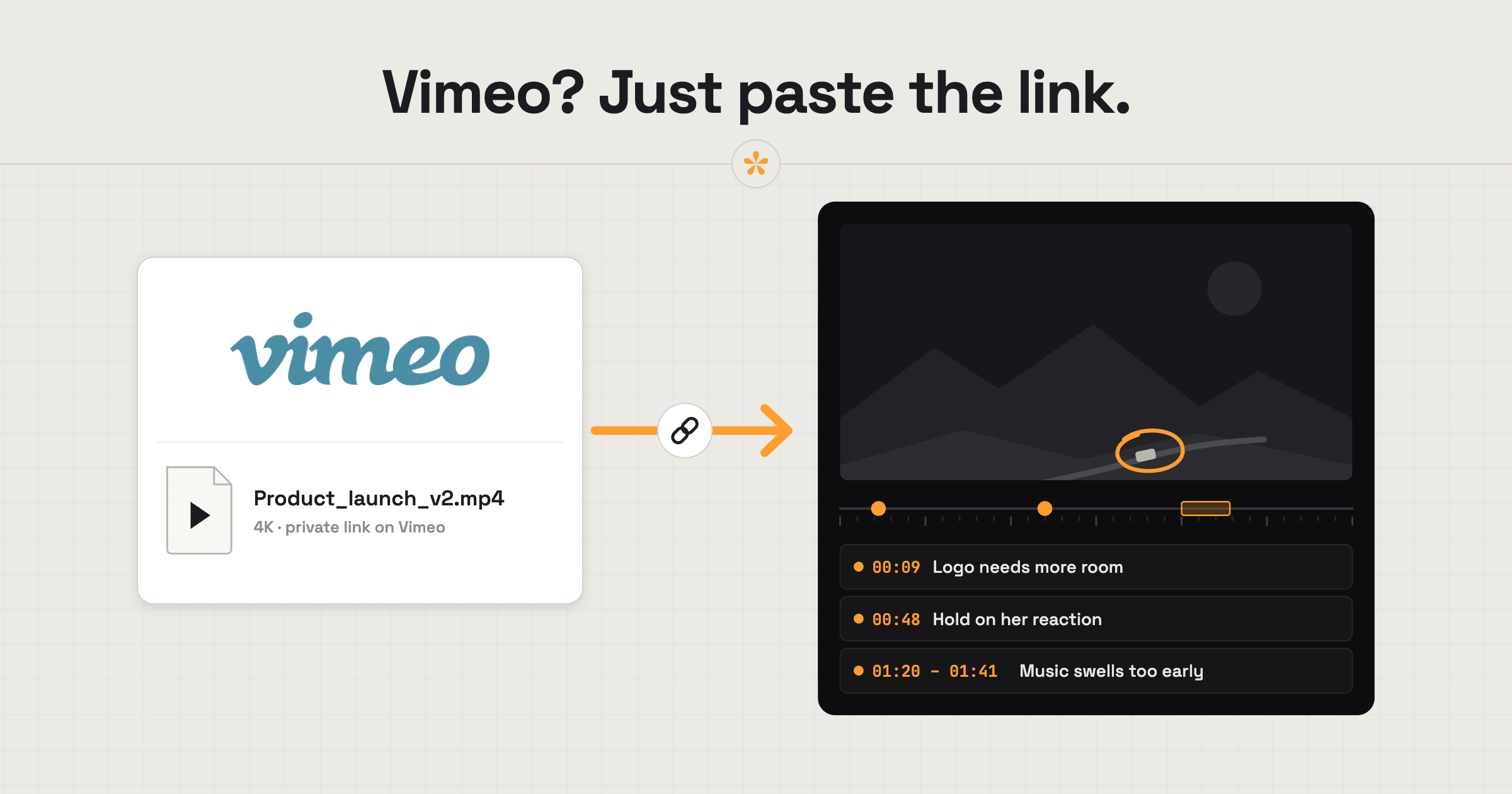
To get feedback on a Vimeo video, make sure the video can be embedded, paste its link into SceneNote and send the client the review link it creates. Public and Unlisted Vimeo videos both work. The video stays on Vimeo, and the client leaves notes on the exact moments, with no account.
The short version
- In Vimeo, set the video to Public or Unlisted.
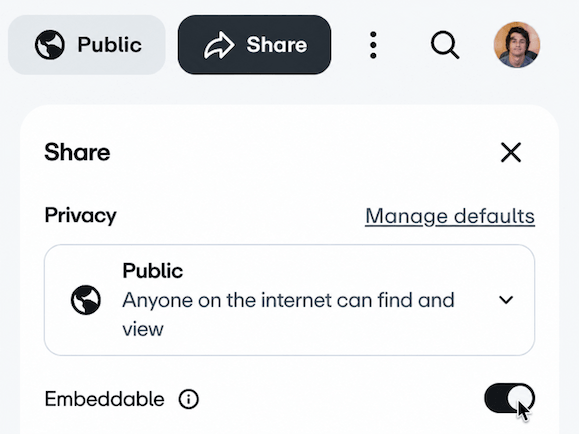
- Click Share and switch on Embeddable.
- Copy the video's full link.
- Paste it on scenenote.app and create the project.
- Send the client the review link.
- For the next cut, add its Vimeo link as v2 in the same project.
ON THIS PAGE · 6 SECTIONS
Why isn't a Vimeo link enough on its own?
Vimeo is a lovely place to host and show work, and plenty of filmmakers keep their whole portfolio there. But a Vimeo link on its own is just for watching. The notes end up in a separate document or an email, so the link doesn't really help with the feedback itself.
Vimeo does have its own review tools. If you already pay for Vimeo and its review tools do what you need, it makes sense to keep everything there. If you want more than comments, a SceneNote project from the same link adds drawing on the frame, voice notes, polls and markers for your editor, and reviewers only type a name, with no email needed.
| Plain Vimeo link | SceneNote project from the same link | |
|---|---|---|
| Notes on the exact moment | Rough times in an email | Pinned to the frame |
| Drawing, voice notes, polls | No | Yes |
| Replies on each note | No | Yes, with email alerts |
| Versions and sign-off | By file name | v1, v2, v3 and an Approve button |
| Notes into your edit | Retype them | Markers for Premiere Pro or DaVinci Resolve |
| Reviewer account | None needed to watch | None needed to comment |
How do you set it up, step by step?
Setting up feedback on a Vimeo video takes about a minute.
- Check who can watch. In your Vimeo library, open the video's privacy setting and choose Public or Unlisted. Private videos can't play outside Vimeo.
- Allow embedding. Click Share and switch on Embeddable.
- Copy the full link. For an Unlisted video, the link includes an extra string of numbers after the video's ID. Keep it: without it, the video won't play.
- Paste it on scenenote.app and click Create project. The video plays from Vimeo; nothing is copied into SceneNote.
- Send the client the review link, with an optional pre-watch note.
What can your client do once it's set up?
Once a Vimeo video is in SceneNote, your client reviews it like any other project.
- Leave notes on the exact moment, or mark a whole section with a range note.
- Draw on the paused frame to point at something.
- Record a voice note of up to 60 seconds, which is transcribed.
- Reply to other people's notes to settle a question where it was asked.
- Answer a poll when you need a decision.
- Approve the final cut, with their name and the date on record.
You can export their notes as markers for Premiere Pro or DaVinci Resolve. Transcription and side-by-side compare need an upload, though.
How do you add the next cut as a new version?
To add the next cut, upload it to Vimeo as a new video, set the same privacy and embed settings, and add its link to the same SceneNote project with + version. The client keeps one review link and lands on the latest cut, while older versions stay with their notes.
Vimeo can also replace a video's file under the same link. For review, it's tidier to upload each cut as its own video, so v1 in SceneNote still shows v1.
How to handle common problems
“This video can't be played here”
If SceneNote shows that the Vimeo video can't be played, embedding is switched off. In Vimeo, click Share and switch on Embeddable. If you've limited embedding to specific domains on a paid Vimeo plan, add scenenote.app to the list instead.
The video is set to Private
If the video is Private in Vimeo, it can't play anywhere outside Vimeo. Switch it to Unlisted, which keeps it off your profile and out of search, and paste the new link.
The Unlisted link is missing its extra numbers
If an Unlisted video won't play, check the link. Unlisted Vimeo links carry an extra string of numbers after the video's ID, and the video only plays with it. Copy the link again from Vimeo's Share panel.
The client opens an old link
If the client watches an old cut, they probably opened an earlier Vimeo link. Send one SceneNote review link instead, and add every new cut to it as a version.
FAQ
Does the client need a Vimeo account?
No. The client doesn't need a Vimeo account or a SceneNote account. They open the review link and type a name the first time they leave a note.
Does a Vimeo project use SceneNote storage?
No. The video plays from Vimeo, so a link project uses no SceneNote storage.
Can I password-protect a Vimeo project?
Yes, on Pro. You can put a password on a project made from a Vimeo link, just like on an upload or a YouTube link. The video itself still lives on Vimeo, where its own privacy settings apply.
Does it work with a free Vimeo account?
Yes, as long as the video is Public or Unlisted and Embeddable is switched on. Limiting embedding to specific domains needs a paid Vimeo plan, but you don't need it.
What's the easiest way to get feedback on a Vimeo video?
Set the video to Unlisted, allow embedding anywhere, paste the full link into SceneNote and send the client the review link. Your work stays on Vimeo, and you get all of SceneNote's feedback tools on top.
Turn a Vimeo link into a review room.
No sign-up needed. Just paste the link.
Related guides

Kiril Dobrev
Filmmaker · part of the team behind SceneNote
Kiril Dobrev is a filmmaker with 15 years of experience and a passion for documentary and travel. He’s spent a lot of that time in the editing room, obsessing over how to make his workflow better, and the feedback loop has always been a big part of that. Post-production still hasn’t had a good enough answer to it. SceneNote was born from that, with one simple idea: make feedback better.
More guides by Kiril →